.jpg)
Vitiligo on the face: treatment options, safe UVB at home and daily skin care
Light patches around the eyes, lips or nose, or along the hairline, are difficult to overlook – after all, the face is what others notice first. Yet there is genuinely hopeful news here: dermatologists see again and again that the face belongs to the areas that react best to treatment. With a well-planned approach, the first small islands of colour frequently return on the face before anywhere else.
- On the face, vitiligo most commonly develops around the eyes, the mouth, the sides of the nose and the hairline.
- According to the British Association of Dermatologists, facial skin tends to repigment better and faster than the hands or feet.
- Tacrolimus ointment is widely used on the face; since 2023 a ruxolitinib cream has also been authorised in the EU for vitiligo involving the face, for patients from 12 years of age.
- The next step is narrowband UVB light (311 nm), which can also be used at home with a handheld lamp – always with eye protection.
- Daily sunscreen and gentle camouflage help in the meantime, while the skin repigments.
Where vitiligo on the face tends to appear
The most typical starting points are the eye area including the lids, the lips and the corners of the mouth, the skin next to the nostrils, the forehead, and the edges of the hair and beard. The patches are milk-white with crisp borders, and they neither hurt nor itch. Eyebrows, lashes or beard hairs growing inside a patch may lose their colour too. Some people develop patches on the lips and the fingertips at the same time – a pattern doctors call acrofacial or "lip-tip" vitiligo.
Why facial vitiligo responds so well
Pigment that comes back usually originates from pigment cells tucked away inside the hair follicles. The face is densely packed with fine follicles and has an excellent blood supply, so it holds many reserves from which colour can spread out again. This is why repigmentation on the face so often begins as small brown freckles that slowly join together – and why starting early, while the patches are still recent, is well worth it.

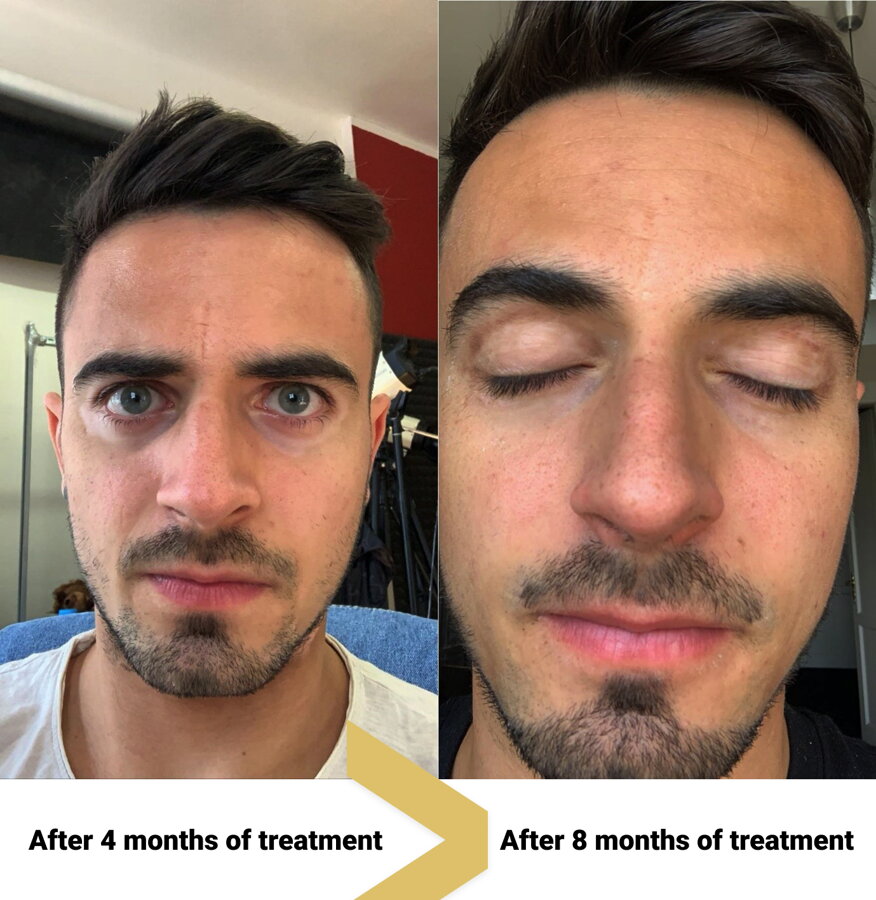
Treatment options for vitiligo on the face
Because facial skin is thinner and more sensitive, the approach is slightly different from other parts of the body. Based on the British Association of Dermatologists guideline, your dermatologist may propose:
- Tacrolimus ointment – frequently the first choice on the face, because, in contrast to strong corticosteroid creams, it causes no skin thinning. Corticosteroids are reserved for short courses at most and are never applied near the eyes.
- Ruxolitinib cream – authorised in the EU since April 2023 for non-segmental vitiligo with facial involvement from the age of 12. Your dermatologist can tell you whether it suits you and whether the cost is covered in your country.
- Narrowband UVB light (311 nm) – at a clinic or with a handheld lamp at home, often combined with a cream.
How to use a UVB lamp safely on your face
A handheld 311 nm UVB lamp lets many of our customers deal with facial patches at home. Keep these rules in mind:
- Protect your eyes every time. Wear UV safety goggles and close your eyes. Treat the eyelids themselves only after a dermatologist has demonstrated how to do it safely.
- Short at first, then gradually longer. Begin with a very brief exposure and only extend it if your skin shows no redness the following day. The skin of the face reddens more readily than that of the hands.
- Two or three sessions a week, at least 48 hours apart.
- Get the skin ready. Our customers spread Vitistop Gel on the patches half an hour beforehand and add one daily Vitistop tablet, a source of copper, which contributes to normal skin pigmentation.
Small facial patches are easy to target with the compact Philips BU-1S; for patches in the beard or on the scalp, take a look at the Kernel KN-4003BL2, whose comb attachment reaches the skin between the hairs. To learn more about light treatment, see our article on phototherapy.

Sun protection for vitiligo on the face
Depigmented patches have no natural defence against UV and burn very quickly – and sunburn can cause vitiligo to spread. A tan on the surrounding skin also makes the patches more conspicuous. From spring through autumn, apply a high-protection facial sunscreen daily, reapply it while you spend time outside and add a broad-brimmed hat. Carefully dosed light from a 311 nm lamp has nothing in common with unprotected sunbathing.
Covering vitiligo on the face
Camouflage works perfectly well alongside treatment and can restore a great deal of self-confidence. For the face, our customers like to use:
- Vitistop Self-Tanning Mousse – use just a little and work it in with the Mini Mitt, or with a cotton bud near the eyes, lips and hairline. Expect the colour to last around five to seven days.
- For immediate coverage, a cover cream or make-up from our camouflage selection.
Would you like a plan for your face? Send us a few details about your skin – Peter (living with vitiligo himself since 2016) and his team will gladly help.
Open the treatment guideOur customers' resultsFrequently asked questions
Can vitiligo on the face be treated?
Yes. Of all body areas, the face is among the most responsive. Options include tacrolimus ointment, a ruxolitinib cream authorised in the EU since 2023 for vitiligo involving the face, and narrowband UVB light, offered at clinics and also available as handheld lamps for home use.
How quickly can facial vitiligo repigment?
Everyone's skin is different. On the face, the first small dots of pigment often show up sooner than elsewhere – within a few months of regular treatment, many people can make them out. Big or older patches need longer.
Can I use a UVB lamp on my face?
Yes, with care. Wear UV safety goggles and keep your eyes shut, start with very short sessions, extend them only if no redness appears and stick to the manual. Anyone taking light-sensitising medication should speak to a doctor first.
Does vitiligo on the face spread?
It can, particularly while the vitiligo is active. Your best chance of stabilising it and regaining pigment comes from preventing sunburn, rubbing and skin injuries, and from beginning treatment early.
What is the best way to cover vitiligo on the face?
A thin layer of self-tanning mousse, blended with a Mini Mitt or a cotton bud, provides natural-looking colour for about five to seven days. If you need instant coverage, use a cover cream or make-up made for vitiligo.
Vitiligo on other parts of the body
Sources: Eleftheriadou V. et al.: British Association of Dermatologists guidelines for the management of people with vitiligo 2021, Br J Dermatol 2022; European Medicines Agency (EMA) – Opzelura (ruxolitinib cream); DermNet – Vitiligo.
This article is general information and does not replace advice from a doctor. Vitiligo should be diagnosed by a dermatologist or another qualified doctor, and any new or changing patch of skin deserves a medical check. Our products are meant to support skin care alongside the treatment your doctor recommends.