.jpg)
Vitiligo on hands: causes, treatment options and everyday hand care
Pale patches on the back of the hand, over the knuckles or around the wrist are very often where vitiligo first becomes noticeable. Because our hands are in view all day, it is natural that this is the area many people find hardest to live with. The encouraging part: treating them follows a clear, stepwise path, and plenty of our customers have won back colour on their hands simply by sticking with it.
- Hands, wrists and fingers rank among the sites most frequently affected by vitiligo.
- Rubbing, minor injuries and frequent hand washing can set off new patches – a reaction known as the Koebner phenomenon.
- Hands tend to respond more slowly than the face or neck. Count in months rather than weeks, and stay consistent.
- Treatment usually begins with a cream or ointment prescribed by your doctor or dermatologist, followed by narrowband UVB light (311 nm) – which can also be given at home with a handheld lamp.
- Sun protection and well-chosen camouflage make daily life easier while the skin regains pigment.
How vitiligo on hands appears
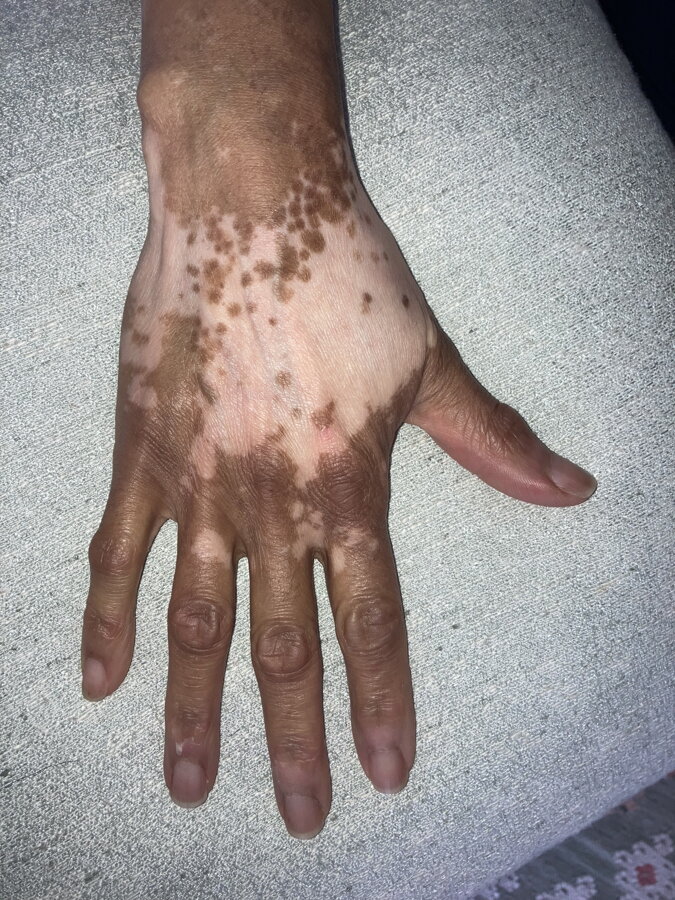
Vitiligo shows itself as sharply outlined, milky-white areas where the skin has stopped producing pigment (melanin). On the hands it usually begins on the back of the hand, over the knuckles, on the wrists or at the fingertips, and it frequently affects both hands at once in an almost mirror-image pattern. There is no pain and the skin's texture stays the same – only its colour changes. On fair skin the patches can be barely visible in winter, then stand out much more in summer once the surrounding skin tans.
If a patch itches, flakes or turns red, ask a doctor to confirm the diagnosis – a fungal infection or the pale marks left behind by eczema can look very similar.
Why the hands are so often the first place affected
Vitiligo is an autoimmune condition in which the immune system mistakenly attacks the skin's own pigment cells (melanocytes). Nobody can yet say for certain why it begins in one spot rather than another, but the hands share two features with other areas where vitiligo is typical:
- Constant friction and minor injuries. Pressure, scratches and small burns – even a tight ring or watch strap – can provoke new patches in people who are prone to vitiligo. Dermatologists refer to this as the Koebner phenomenon.
- Lots of washing and harsh substances. Washing-up liquid, solvents and household cleaners dry out and irritate the skin. Some chemicals, including certain phenol-containing products, are also known to trigger pigment loss.
For this reason, looking after your hands every day matters just as much as the treatment itself.
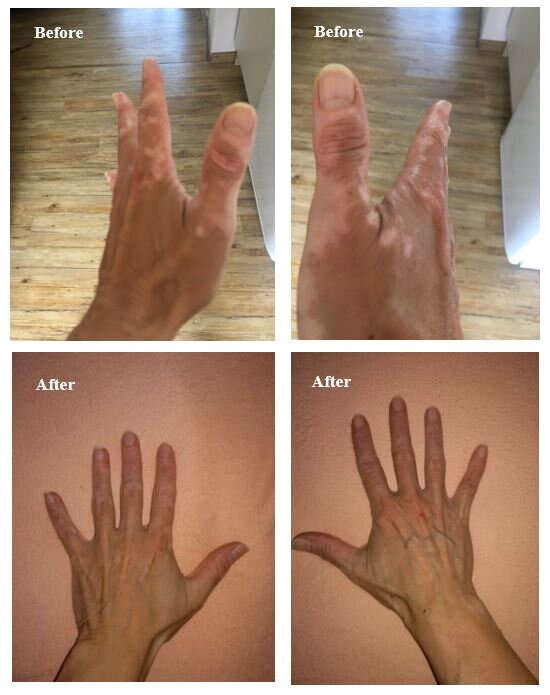
Treatment options for vitiligo on the hands
The British Association of Dermatologists guideline, one of the most thorough sets of recommendations available in Europe, lays out a clear sequence. Your dermatologist will adapt it to your situation:
- A prescription cream to begin with. Away from the face, the first step is usually a potent corticosteroid cream for a limited period, sometimes applied on an on-and-off schedule. Tacrolimus ointment may also be an option.
- Narrowband UVB light (311 nm). When creams alone are not enough, NB-UVB is the recommended form of phototherapy – at a clinic or at home with a handheld lamp. For the hands, a handheld device is particularly convenient: a session takes only a few minutes and spares you two or three clinic visits every week.
- Combining approaches. Light therapy is frequently paired with a treatment applied to the skin. The guideline also points out that the face and trunk usually regain colour more readily than the hands and feet – so on the hands, persistence is what counts most.
Recent, active patches generally react better than ones that have been white for many years, which makes an early start worthwhile.
UVB light therapy for hands at home: what our customers do
Most customers with vitiligo on their hands follow these steps with a handheld 311 nm UVB lamp:
- Spread Vitistop Gel over the patches and allow around 30 minutes for it to work.
- Expose the hands to the lamp two or three times a week, leaving at least 48 hours between sessions. Begin with a very short exposure and extend it step by step only if the skin is not red the following day – just as the lamp's user manual describes.
- Take one Vitistop tablet daily – it provides copper, which contributes to normal skin pigmentation, along with zinc and other nutrients.
- Shield the patches from sunburn in summer and take a photo every four weeks; it reveals progress that is easy to overlook from one day to the next.
Which lamp is right for you? Our best-selling model is the compact Philips BU-1S, while the Philips BU-10 adds a built-in timer for accurate dosing. You will find every model in our UVB light therapy category, and the whole process explained step by step in our treatment guide.
Protecting your hands day to day
- Gloves for housework. They guard against friction, chemicals and small cuts when you do the dishes, clean or work in the garden.
- Mild cleanser and hand cream. Pick a gentle, fragrance-free wash and apply cream each time you have washed your hands.
- Avoid repeated rubbing. Tight rings, watch straps or bag handles pressing on the same spot can set off new patches.
- Sun protection. Depigmented skin burns quickly. Put a high-SPF sunscreen on the backs of your hands – including when you are behind the wheel.
How to cover vitiligo on hands
While repigmentation is under way, camouflage can do a great deal for how you feel. On the hands, self-tan tends to be the most practical choice, as it does not transfer to clothing and survives hand washing:
- Vitistop Self-Tanning Mousse develops a natural-looking tint within a few hours that typically lasts five to seven days. The Mini Mitt helps you blend it precisely over hands and knuckles.
- For instant coverage on a special occasion, browse our camouflage products.
Unsure where to begin with your hands? Tell us about your skin – Peter, who has had vitiligo himself since 2016, and his team will put together a suitable plan with you.
Open the treatment guideOur customers' resultsFrequently asked questions
Can pigment come back on hands affected by vitiligo?
Yes, the hands can repigment. Because they usually react more slowly than the face or neck, it typically takes several months of consistent treatment – most often prescription creams and narrowband UVB light – before the change becomes obvious. Newer patches tend to respond better than older ones.
Why did my vitiligo begin on my hands?
Hands face constant friction, small injuries, frequent washing and contact with chemicals. In people predisposed to vitiligo, this kind of strain can trigger new patches (the Koebner phenomenon), which is why the hands, wrists and fingers are among the most common starting points.
Is a home UVB lamp safe to use on vitiligo on the hands?
Handheld narrowband UVB lamps emit the same 311 nm light that dermatology clinics use. Start with very brief sessions, lengthen them only when no redness appears, protect your eyes and follow the manual. If you take any medication that makes your skin more sensitive to light, check with your doctor first.
How long do hands take to repigment?
It differs from person to person. Many people spot the first small dots of pigment after a few months of regular treatment, while larger areas may need a year or longer. A photo every four weeks under the same lighting shows progress most clearly.
What is the best way to conceal vitiligo on the hands?
A self-tanning mousse such as Vitistop Self-Tanning Mousse gives a natural-looking tint that generally lasts five to seven days and stays put when you wash your hands. Cover creams and make-up work well for special occasions.
Vitiligo on other parts of the body
Sources: Eleftheriadou V. et al.: British Association of Dermatologists guidelines for the management of people with vitiligo 2021, Br J Dermatol 2022; European Medicines Agency (EMA) – Opzelura (ruxolitinib cream); DermNet – Vitiligo.
This article is general information and does not replace advice from a doctor. Vitiligo should be diagnosed by a dermatologist or another qualified doctor, and any new or changing patch of skin deserves a medical check. Our products are meant to support skin care alongside the treatment your doctor recommends.