.jpg)
Vitiligo on fingers and fingertips: treatment, protection and camouflage
White fingertips, pale knuckles or a light ring of skin around a nail: vitiligo on the fingers is very widespread, and since our hands are busy from morning to night, it is difficult to forget about. The fingers have a reputation as the slowest area to improve – so this guide focuses on what you can actively do: a realistic plan, good protection for the skin and camouflage that really lasts.
- The fingers, fingertips and knuckles are some of the most typical places for vitiligo to appear.
- White patches on the lips combined with patches on the fingertips are a familiar pattern, known as acrofacial or "lip-tip" vitiligo.
- Fingertips contain hardly any hair follicles, which are the main reservoir of returning pigment – that is why they need the longest and steadiest treatment.
- Shielding the skin from rubbing and minor injuries lowers the risk of new patches.
- A self-tanning mousse gives the fingers a natural-looking shade that copes with frequent hand washing.
Why vitiligo so often affects the fingers
In vitiligo, the immune system destroys pigment cells, and the condition likes to develop where the skin is constantly rubbed or slightly injured. Few parts of the body are kept as busy as the fingers – keyboards, door handles, dishes, knives, garden tools – and all of that strain adds up. In people with a tendency to vitiligo, this kind of repeated stress can lead to new patches, which doctors describe as the Koebner phenomenon. On the fingers, the patches frequently develop on both hands in a matching pattern.
Why fingertips repigment more slowly – and why treating them is still worthwhile
New colour in a vitiligo patch usually starts from pigment cells in the hair follicles: tiny brown specks appear, grow and eventually join up. Fingertips and the inner surface of the fingers have practically no follicles, and the British Association of Dermatologists points out that the hands and feet as a whole respond less readily than the face and trunk. What this means for you:
- the upper side of the fingers and the knuckles, where fine hairs grow, generally improve earlier than the tips;
- colour on the fingers frequently creeps in from the border of a patch towards its centre;
- it makes sense to judge the results over many months, comparing photos taken every four weeks.
A slower response is not the same as no response – the pictures our customers send us prove that fingers can regain colour as well.

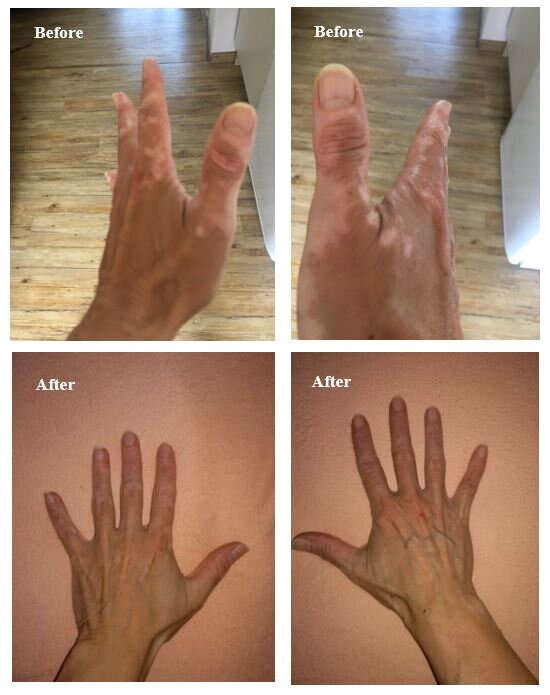
Treatment options for vitiligo on the fingers
A dermatologist will normally begin with a prescription product, most often a potent corticosteroid cream for a set period or tacrolimus ointment. Where this does not bring enough improvement, the next recommended option is narrowband UVB light at 311 nm. Handheld lamps are ideal for fingers: the surface to treat is small, so both hands can be done at home within minutes, two or three times a week.
Many of our customers proceed like this:
- Smooth Vitistop Gel over the affected fingers and knuckles, then wait roughly half an hour.
- Use a 311 nm lamp – for example the Philips BU-1S or the Philips BU-10 – two or three times weekly, with a gap of 48 hours or more between sessions. Keep the first exposures very short and lengthen them only while the skin stays free of redness. Hold your fingers apart so their sides are lit too.
- Have one Vitistop tablet every day; it supplies copper, which contributes to normal skin pigmentation.
- Do not give up when progress seems to stall – no other area rewards staying power as much as the fingers.
For a week-by-week description of the whole process, see our treatment guide.
Protecting your fingers in daily life
- Gloves whenever you clean, do the dishes, garden or work with tools.
- Hands off the cuticles – picking or nail-biting creates small wounds that may set off new patches.
- Rings with a little room, so they do not chafe one spot all day.
- A good hand cream after each wash to keep the skin soft.
- SPF on sunny days for the backs of your hands and fingers, since unpigmented skin burns in no time. Browse our sun protection range.
How to cover vitiligo on fingers
Ordinary make-up wears off the fingers within hours, simply because hands are washed so frequently – self-tan is the far more reliable option. Spread Vitistop Self-Tanning Mousse with the Mini Mitt and touch up the knuckles and nail folds with a cotton bud; the shade normally stays for five to seven days. Rinse your palms afterwards so they stay untinted. Further options are available in our camouflage selection.
Questions about vitiligo on your fingers? Drop us a line – Peter, who has had vitiligo himself since 2016, and his team will be glad to advise you.
UVB lamps for home useOur customers' resultsFrequently asked questions
Why do fingertips with vitiligo take so long to respond?
Pigment that comes back is supplied mainly by pigment cells in hair follicles, and the fingertips have almost none. As a result they regain colour more slowly than the face, the neck or the upper side of the hands. Repigmentation is still achievable, but it calls for steady treatment over many months.
What does lip-tip vitiligo mean?
Lip-tip vitiligo – also called acrofacial vitiligo – describes white patches that develop on the lips and fingertips, occasionally on the toes as well. Treatment follows the same principles as for other non-segmental vitiligo.
Is a home UVB lamp suitable for vitiligo on the fingers?
Yes. Small areas such as fingers are well suited to a handheld 311 nm narrowband UVB lamp. Keep the first sessions very short, extend them only if the skin does not redden, shield your eyes and follow the instructions supplied with the device.
How can I keep vitiligo on my fingers from spreading?
Minimise rubbing and small injuries: put on gloves for household chores, do not pick at the cuticles, keep rings loose and avoid sunburn. The earlier treatment begins, while patches are still fresh, the better the outlook.
How can I disguise vitiligo on my fingers?
Self-tanning mousse, spread with a Mini Mitt or a cotton bud, gives a natural shade that survives hand washing and normally lasts five to seven days.
Vitiligo on other parts of the body
Sources: Eleftheriadou V. et al.: British Association of Dermatologists guidelines for the management of people with vitiligo 2021, Br J Dermatol 2022; European Medicines Agency (EMA) – Opzelura (ruxolitinib cream); DermNet – Vitiligo.
This article is general information and does not replace advice from a doctor. Vitiligo should be diagnosed by a dermatologist or another qualified doctor, and any new or changing patch of skin deserves a medical check. Our products are meant to support skin care alongside the treatment your doctor recommends.