.jpg)
UVB 311 nm or excimer 308 nm: which light is better for vitiligo?
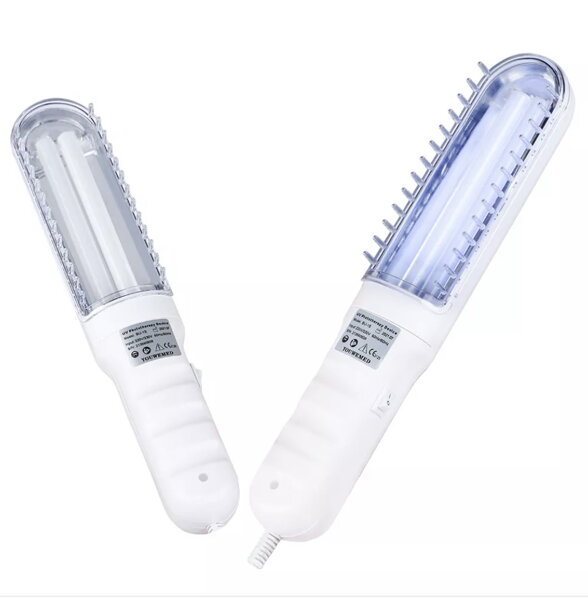
If you have looked into light treatment for vitiligo, you will have met two numbers: 311 and 308. The first is narrowband UVB (NB-UVB), used in dermatology clinics and in handheld lamps for home use. The second is the excimer laser or excimer lamp, which emit monochromatic 308 nm light and are available at specialist centres. A three-nanometre difference sounds negligible – in practice it decides how the light is dosed, how quickly results appear and how much it costs.
What both methods have in common
Both wavelengths sit in the UVB band and work on the same principle. Light at around 310 nm penetrates the epidermis and upper dermis, where it does three things at once: it dampens the activity of the T cells that destroy pigment cells (an immunomodulatory effect), it stimulates keratinocytes to release growth factors, and it activates the reservoir of melanocyte stem cells in the hair follicles. It is from the follicles that pigment returns – which is why the first signs of repigmentation appear as tiny brown dots around the hairs that gradually merge.
The 308–311 nm band is no accident. Studies from the 1980s and 1990s showed that shorter wavelengths (below 300 nm) cause erythema – redness and skin damage – long before they can stimulate pigment. Longer wavelengths (UVA, 320–400 nm) penetrate deeper but stimulate melanocytes weakly, and without psoralens hardly at all. The window around 310 nm is the compromise with the best ratio of effect to safety.
Narrowband UVB 311 nm: the standard for more extensive vitiligo
NB-UVB uses fluorescent tubes (most often Philips TL-01, or PL-S 9W/01 in handheld lamps) with a narrow emission peak at 311 nm. The light is applied to the whole body in a cabinet or locally with a handheld lamp. The British Association of Dermatologists guideline (BAD 2021) and the Vitiligo European Task Force (VETF) regard NB-UVB as first-line treatment for non-segmental vitiligo affecting more than 5–10 % of the body surface or spreading quickly.
- Frequency: 2–3 sessions a week, at least 48 hours apart.
- Dosing: start at 0.1–0.25 J/cm² (handheld lamps: 15–30 seconds) and increase by 10–20 % each session until a faint pinkness appears that fades within 24 hours.
- Course length: first dots after 1–4 months, full effect after 9–12 months; assess at 3 months and continue if repigmentation is under way.
- Expected result: in a meta-analysis (Bae et al., JAMA Dermatology 2017, 35 studies) 74 % of patients achieved at least 25 % repigmentation after 6 months and about 36 % achieved 75 % after one year. Face and neck respond best, hands and feet worst.
The big advantage is availability: the same tube used in the clinic is found in a handheld lamp, so treatment can continue at home, regularly, for years. The disadvantage is that the light also reaches the healthy skin around the patch, which tans and temporarily increases the contrast.
Excimer laser and excimer lamp 308 nm: targeted treatment of small areas
The excimer laser (XeCl) emits coherent light at exactly 308 nm through a small applicator, usually 2–3 cm². The excimer lamp (for example MEL-type systems) emits the same wavelength but incoherently and over a larger area. In both cases the light is applied to the patch only; healthy skin is left untouched. This allows considerably higher doses (starting at 100–200 mJ/cm², increasing by 50–100 mJ/cm²) without tanning the rest of the body.
- Indication: localised vitiligo up to roughly 10 % of body surface, segmental vitiligo, face and neck, patches resistant to NB-UVB.
- Frequency: 2–3 times a week, usually 24–48 sessions.
- Speed: first dots often after 4–8 sessions, faster than NB-UVB.
- Limits: clinic only, cost per session, impractical for extensive vitiligo (each patch is treated separately).
What the comparative studies say
There are not many head-to-head comparisons, but they are consistent. In a randomised half-face study (Casacci et al., JEADV 2007) the 308 nm excimer lamp was more effective than NB-UVB after 6 months: more than 75 % repigmentation was achieved in 37.5 % of excimer-treated patches versus 6 % with NB-UVB. The meta-analysis by Lopes et al. (American Journal of Clinical Dermatology 2016) concluded that both the excimer laser and the excimer lamp are slightly more effective and faster on localised patches, while the difference between laser and lamp was not significant. A network meta-analysis (2022, 13 studies) also pointed out that the gap narrows with longer treatment – after 9–12 months NB-UVB catches up.
In practice: if you have a few patches on the face and access to an excimer clinic, you will see results sooner. If you have patches in several places, on hands and feet, or need to keep treating for years, NB-UVB is the more sensible and cheaper route – and it can be done at home.
| Criterion | NB-UVB 311 nm | Excimer 308 nm |
|---|---|---|
| Light source | fluorescent tube (Philips /01) | XeCl laser or excimer lamp |
| Treated area | whole body or 40–55 cm² (handheld lamp) | patch only, 2–3 cm² (laser) / larger (lamp) |
| Suited to | extensive or spreading vitiligo, long-term treatment | localised vitiligo, face, segmental, resistant patches |
| First signs | 1–4 months | often 4–8 sessions |
| Length of treatment | 9–12 months, maintenance possible | 24–48 sessions |
| Where | clinic or home (handheld lamp) | clinic only |
| Tanning of surrounding skin | yes | minimal |
| Cost | one-off lamp, then almost nothing | payment per session |
Safety: what applies to both wavelengths
The most common side effect is erythema (sunburn) when the dose is increased too quickly, plus temporary itching and dry skin. With the excimer, blistering on the patch is more common because of the higher doses. The long-term skin-cancer risk of NB-UVB is low according to the cohort studies so far (including more than 3,800 patients in a dermatology registry), and no increase over the general population has been confirmed in vitiligo patients; it is still recommended not to exceed about 200 whole-body sessions a year and to protect the eyes with goggles. The same rules apply to a handheld lamp at home: increase the dose gradually, treat only the patches, wear goggles when treating the face and do not treat on a day the skin has been in the sun.
Phototherapy is not suitable for photosensitive conditions (lupus, porphyria), while taking photosensitising medicines without medical advice, or with a history of skin cancer. In pregnancy NB-UVB is considered safe, but it is worth discussing with your doctor.
How to get more out of the light
Light is the engine of repigmentation, but not the only factor. Combining it with topical calcineurin inhibitors (tacrolimus) improves results on the face and neck; with 308 nm, the combination with tacrolimus is more effective in studies than the laser alone. Since 2023 a ruxolitinib cream (Opzelura) has been available in the EU and the UK, and in studies it combines well with NB-UVB. Among freely available options, our customers apply a gel with psoralens from Babchi oil before each session (Vitistop Gel), which increases the skin’s sensitivity to UVB, and support copper, zinc and L-tyrosine intake with tablets (Vitistop tablets). The full step-by-step routine is in our treatment plan.
The biggest influence, however, is something that costs nothing: consistency. In NB-UVB studies the best results go to patients who do not miss sessions in the first three months. That is exactly why a home lamp makes sense – 2–3 short sessions a week are easier at home than travelling to a clinic.
Which option for whom
- A few patches on the face or neck, segmental vitiligo: excimer 308 nm at a clinic if available; otherwise a handheld NB-UVB lamp with a comb attachment.
- Patches in several places, hands, elbows, knees: NB-UVB 311 nm – a whole-body cabinet at the clinic or a handheld lamp at home for individual areas.
- Rapidly spreading vitiligo: stabilisation first (dermatologist, possibly systemic treatment), then NB-UVB.
- Patches that have not responded after a year of NB-UVB: try the excimer or a combination with topical treatment; hairless hands and feet have a limited melanocyte reservoir and respond worst to both methods.
Browse the handheld 311 nm UVB lamps we offer, or tell us where your patches are – we will advise whether home phototherapy makes sense for you.
Want advice on where to start? Tell us where your patches are and for how long – we reply within one working day with a concrete suggestion.
Write to us UVB lamps 311 nmFrequently asked questions
Is the excimer laser safer than UVB 311 nm?
It is not safer, it is more targeted. With the excimer the healthy skin is untouched, but higher doses are used on the patch, so local redness and blisters are more common. The long-term risk of both methods is considered low when dosing is followed.
Can I use a 308 nm lamp at home?
Excimer 308 nm lamps are medical devices intended for clinics; they are not normally sold for home use in Europe. Home handheld lamps use a 311 nm tube, which has the same mechanism and comparable results in long-term treatment.
How many excimer sessions do I need?
Usually 24–48 sessions, 2–3 times a week. First signs of repigmentation often appear after 4–8 sessions, especially on the face.
What if a patch responds to neither light?
Patches without hairs (fingers, wrists, ankles, lips) have few melanocyte stem cells and respond poorly to any phototherapy. Options include combination with topical treatment, surgical melanocyte transfer (for stable vitiligo) or camouflage.
Can a home lamp be combined with clinic sessions?
Yes, but not on the same day and always with your doctor’s knowledge so that doses are not added up. A common approach is a course at the clinic and the home lamp to maintain the result or for areas the cabinet does not reach well.
Read next
Sources: Bae JM et al. Phototherapy for vitiligo: a systematic review and meta-analysis. JAMA Dermatol 2017; Lopes C et al. UVB phototherapy for vitiligo: a systematic review and meta-analysis. Am J Clin Dermatol 2016; Casacci M et al. Comparison between 308-nm monochromatic excimer light and NB-UVB in vitiligo. JEADV 2007; Eleftheriadou V et al. BAD guidelines for the management of people with vitiligo 2021. Br J Dermatol 2022; DermNet – Narrowband UVB phototherapy.
This article is general information and does not replace an examination or advice from a dermatologist or endocrinologist. Our products support skin care alongside the treatment your doctor recommends; results vary from person to person.